
Product Category: Social media, large language models
Founded: 2023
Headquarters: San Francisco, CA
URL: https://x.ai
Business Status: Private
Leadership:
Products: Grok-1, Grok-1.5
Key Customers: X Premium subscribers, future enterprise clients
Key Competitors: OpenAI, Google, Anthropic, Mistral, Meta
Investors: While specific investors in the Grok project are not disclosed, x.ai’s funding rounds in the past include contributions from DCM Ventures, FirstMark Capital, IA Ventures, Lerer Hippeau, and Pegasus Tech Ventures.
X.ai distinguishes Grok and its overall business model through a combination of real-time data integration, a unique personality, and open-licensing. Grok’s access to real-time knowledge via X offers a unique advantage, presenting diverse viewpoints and the possibility of on-the-spot fact-checking. This feature positions Grok as a potentially more updated and versatile tool compared to its contemporaries. Moreover, Grok’s “Fun Mode” promises a more engaging and less sanitized interaction experience, aiming to deliver humor and wit in its responses. However, there are concerns, especially regarding the over-reliance on X for real-time information, which might limit the accuracy and quality of the data. Furthermore, while Grok aims to differentiate itself with unique features like RLHF and a fun mode, no feature will remain unique should it prove popular and ChatGPT, Gemini, and others will release their own spin on those ideas as soon as they are able. Grok shows promise with its novel features and Musk’s ambitious vision, its success will depend ongoing efforts to keep the technical abilities and features enticing to users unsure where to start with generative AI models and chatbots.
Background
Elon Musk established X.ai in 2023 following Musk’s departure from the board of OpenAI and his public disparagement of the company. He gathered other former OpenAI researchers as well as experts from DeepMind, Microsoft, and Google to put X.ai together. Musk made a point of tying his new company to X (formerly Twitter) with the release of ChatGPT competitor Grok and the opening of the Grok-1 LLM to interested developers.
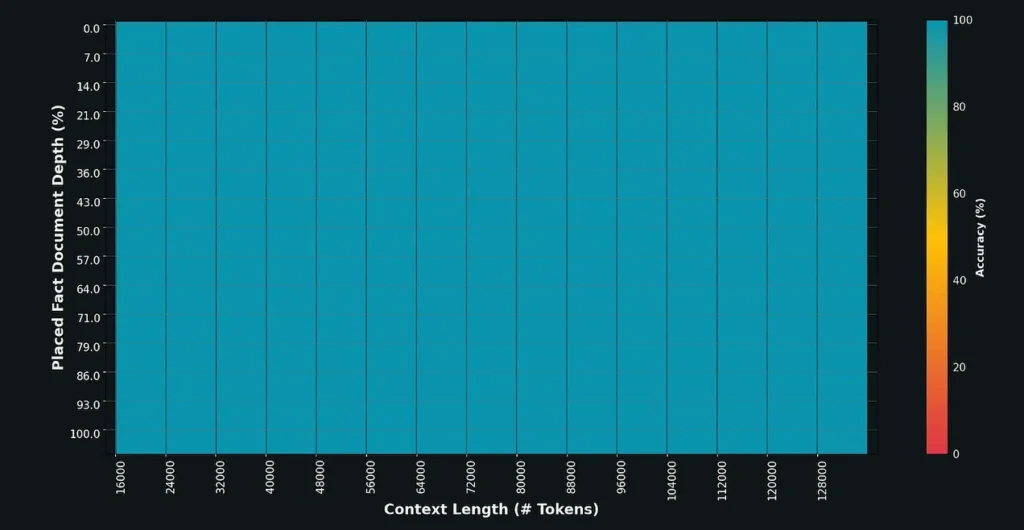
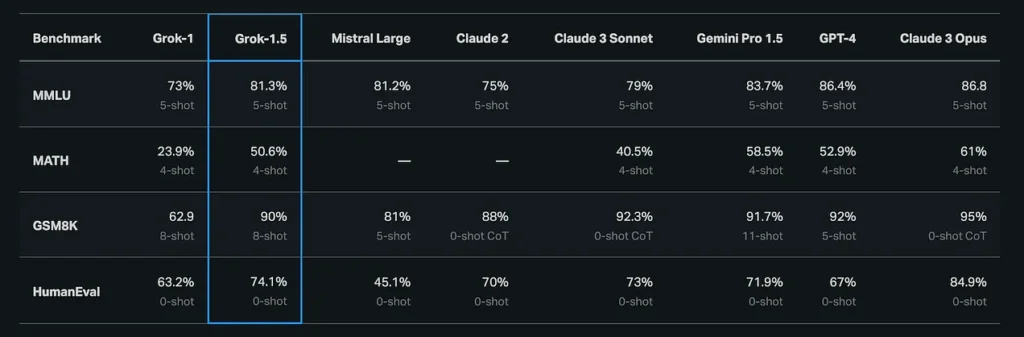
X.ai’s Grok represents a significant advancement in the realm of AI chatbots, powered by its open-license large language model, Grok-1, a Mixture-of-Experts model. Though Grok-1 is supporting the eponymous chatbot, X drew renewed interest with the March, 2024 release of Grok-1.5, a significant evolution from its predecessor in benchmark performances across multiple domains. According to the tests shared by X, Grok-1.5 beats rival models like Mistral Large and Anthropic’s Claude 2 in multiple benchmarks, and even comes out ahead against OpenAI’s GPT-3.5, and only slightly behind GPT-4 and Google Gemini Pro 1.5. Grok-1.5 also boasts a 128K token context window, much larger than available with Grok-1.
While Grok-1.5 is currently in the hands of early testers and not yet publicly available, its predecessor, Grok-1, remains accessible as an open-source model. The anticipation around Grok-1.5 extends to its integration into the Grok assistant, positioning it as a formidable contender to ChatGPT and Inflection’s Pi, among other AI solutions. The future rollout of Grok-1.5 as an inference API will further cement its place in the market, particularly among enterprises that lean towards open-source alternatives, offering a compelling option compared to proprietary models from leading AI developers.
X.ai’s strategic move towards providing Grok-1.5 as part of a broader API offering highlights the company’s commitment to leveraging open-source models to challenge proprietary solutions in the AI space. This approach may not only democratize access to advanced AI capabilities but also stir a significant shift in preference among enterprise users, potentially driving greater adoption of open-source models over their proprietary counterparts.
xAI has successfully raised $134.7 million, aiming for a total of up to $1 billion in funding to fuel its ambitious projects.
X.AI’s main differentiators when it comes to Grok are both technical and qualitative. Elon Musk made a point of pushing for a distinctive personality for the chatbot, an irreverent and at times sarcastic approach to conversation. Grok also stands out by incorporating real-time internet data, primarily from X, to provide up-to-date responses. This approach enables Grok to offer more current information compared to competitors that might rely on static datasets capped at earlier dates. However, this strategy comes with its challenges, particularly concerning data accuracy, given X’s varied content quality. In addition, releasing Grok-1 under the Apache 2.0 license showcases how X.AI wants to claim a distinction from OpenAI’s closed model approach.
X.ai’s speed of development is also notable. The company succeeded in creating multiple iterations of a foundation model in months while its rivals had years, yet X.AI’s are on par or even more advanced. Even just the upgrade from Grok-1 to 1.5 narrowed the performance gap with frontier foundation models like GPT-4 and Claude 3 Opus significantly. Grok-1.5 also shows a crucial divergence from other open models in terms of its long context retrieval results. Grok-1.5 has a 128k token context window, far bigger than the 32k of Databricks’ DBRX or Mistral’s Mixtral. While Anthropic, Google, and OpenAI offer larger context windows than Grok-1.5, 128k is still big enough to potentially entice customers looking for LLMs with better short-term memory.

As the Chief Engineer of xAI, Igor Babuschkin leads technical efforts in advancing artificial intelligence, notably contributing to the development of the Grok product. With a strong background in physics, Igor initially delved into the study of B mesons at Technische Universität Dortmund, where he collaborated on the LHCb experiment at the Large Hadron Collider. Transitioning to machine learning, he joined DeepMind in 2017 as a Research Engineer, playing a pivotal role in projects such as WaveNet and spearheading the engineering on AlphaStar, a groundbreaking deep reinforcement learning agent for StarCraft II. Igor's expertise extends to prominent roles at OpenAI and Google DeepMind, where he consistently demonstrated his research and engineering prowess.

Manuel Kroiss is a professional who has been involved in the field of artificial intelligence and machine learning. He has worked as a software engineer at DeepMind and Google. Additionally, he has contributed to research in the area of distributed machine learning, as evidenced by his work on the "Launchpad: A Programming Model for Distributed Machine Learning Research". Furthermore, he has also been associated with Twitter, where he was involved in developing an alternative to ChatGPT

Tony Wu has dedicated his career to tackling complex mathematical challenges using artificial intelligence. Over the past year, he has driven multiple breakthroughs in this area with his pioneering Minerva project. This system has shown the ability to solve difficult high school math problems better than average human students. Wu believes mathematical reasoning represents the frontier for advancing AI safety and reliability. By building automated mathematicians that match and exceed human reasoning, he hopes to lay a rigorous foundation for trustworthy language models. With leadership roles at top companies and a series of high-impact publications, Wu is quickly becoming an authority on drawing inspiration from mathematics to take on the most difficult problems facing AI.

Christian Szegedy, veteran AI scientist from Google with background in deep learning and computer vision. Jimmy Ba, UofT professor and CIFAR chair, acclaimed for efficient deep learning algorithms. Toby Pohlen, led major projects at DeepMind like AlphaStar and Ape-X DQfD. Ross Nordeen, technical PM from Tesla managing new hires and access at Twitter. Kyle Kosic, full stack engineer and data scientist with experience at OpenAI and Wells Fargo. Greg Yang, Morgan Prize honorable mention with seminal work on Tensor Programs at Microsoft Research. Guodong Zhang, UofT and Vector Institute researcher focused on training and aligning large language models. Zihang Dai, Google scientist known for XLNet and Funnel-Transformer for efficient NLP.
Name: Grok | Version: Grok-1 | Release Date: November 2023 | Developer: XAI |
Model Description | Purpose: General purpose language model powering the Grok AI assistant. Designed to answer questions of all kinds, designed to have a snarky personality. | Architecture: Transformer-based autoregressive model. | Size: Grok-1 unspecified but Grok-0 Stated as 33 billion, context length of 8,192 tokens. |
Capabilities | Strengths: State-of-the-art performance on benchmarks at around 70 billion parameter scale. Specified as strong in mathematical and coding capabilities. Able to access external databases and search tools. | Limitations: Still prone to typical issues like hallucination and contradictory responses. Currently does not have multimodal capabilities | Languages Supported: Currently English-only but multilingual support planned. |
Training Data | Sources: Internet data, existing datasets, and human feedback data. | Time Period: Up to Q3 2023. | Data Cleaning/Preparation: – |
Performance Metrics | Benchmark Results: State-of-the-art among models below 100B parameters on benchmarks like GSM8k, MMLU, and HumanEval. | Comparison with Other Models: Surpasses models like GPT-3.5, Inflection-1. Still below GPT-4. | Human Evaluations: Xai employs AI tutors |
Use Cases | Intended Use:General conversational AI assistant capable of search, writing, editing, coding, and advising across many topics. | Misuse Potential: Interventions made to reduce harms, but issues like confabulation, jailbreaking, and bias are still possible. Trust and safety process helps enforce acceptable use policy. |
|
Ethical Considerations | Bias and Fairness: – | Privacy: – | Safety and Alignment: Adversarial testing performed. |
Technical Requirements | Hardware/Software: |
|
|
Access and Licensing | Availability: early@x.ai for Grok early access | License: Not specified. |
|
Contact Information | Support: Contact through Anthropic website. |
|
X.ai | MMLU (5) | HellaSwag | Truthful QA | Winogrande | ARC-Challenge | GSM8K (5) | Chatbots Arena |
Grok-0 | 65.7 | - | - | - | - | 56.8 | - |
Grok-1 | 73 | - | - | - | - | 62.9 | - |
Grok-1.5 | 81.3 | - | - | - | - | 90 | - |
OpenAI | MMLU (5) | HellaSwag | Truthful QA | Winogrande | ARC-Challenge | GSM8K (5) | Chatbots Arena |
GPT-4 | 86.4 | 95.3 | 0.59 | 87.5 | 96.3 | 93.1 | 1159 |
GPT-3.5 | 70 | 85.5 | 0.47 | 81.6 | 85.2 | 57.1 | 1117 |
© 2024 Synthedia Research